
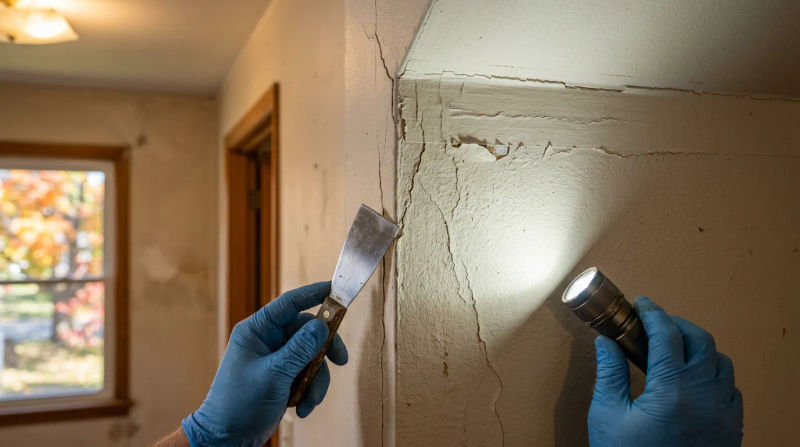
As the crisp October air settles over Battle Ground and heavy leaf fall signals the true arrival of autumn, you finally switch on your furnace for the first time this season. As the warmth fills your home, you glance at the living room wall and notice something that wasn't there during the summer: a thin, spidery crack running along the ceiling line. It might seem like a minor cosmetic issue, but that small line could be an early warning sign of a more significant problem. With over a decade of experience evaluating property issues, I’ve seen how these seemingly small cracks can evolve, especially during the dramatic temperature and humidity shifts we experience when indoor heating season begins.
Common Signs and Symptoms
Drywall cracks are not all the same. Identifying the type of crack you're seeing is the first step in understanding the severity of the issue. Our technicians are trained to spot these distinctions during an initial assessment, but you can learn to identify them as well. Here are some of the most common signs that your drywall needs attention.
- Straight, Thin Hairline Cracks: These are the most common and often appear vertically or horizontally along the seams where two sheets of drywall meet. They indicate that the tape or joint compound beneath the paint has failed due to minor movement.
- Bubbling or Peeling Drywall Tape: If you see areas where the paper tape is lifting away from the wall or has bubbles underneath, this is one of the clearest tape joint failure signs. It means the bond between the tape and the joint compound has broken, and the seam is no longer stable.
- Cracks Radiating from Corners: Cracks that fan out from the corners of windows and doors are stress cracks. These areas are natural weak points in the wall structure, and movement from opening and closing doors, or general house settling, often manifests here first.
- Discolored or Stained Cracks: A crack accompanied by a yellow or brown stain is a red flag. This almost always points to moisture intrusion from a leaky pipe, roof, or window. The drywall has become wet and is losing its structural integrity.
- Recurring Cracks: If you’ve patched a crack before only to have it reappear a few months later, the underlying cause has not been addressed. This is common with seasonal movement; the wall expands and contracts, re-opening the weak point.
- Wide, Jagged, or Stair-Step Cracks: Any crack wider than a quarter-inch, with a jagged pattern, or that follows the pattern of cinder blocks in a foundation wall, should be taken very seriously. These can indicate significant structural or foundation movement that requires immediate professional evaluation.
What Causes This Problem
Understanding why these cracks appear is key to implementing a lasting solution. While a simple patch might cover the problem temporarily, a true fix addresses the root cause. Here are the primary drywall seam crack causes we encounter.
Seasonal Expansion and Contraction: Wood is a hygroscopic material, meaning it absorbs and releases moisture from the air. As we turn on our furnaces in Battle Ground, the indoor humidity drops significantly. The wood framing of your home shrinks as it dries out, pulling on the drywall sheets attached to it. This subtle movement puts immense stress on the inflexible joint compound at the seams, causing it to crack. Homes built in the 1950s, like many of the classic Ranch-style houses in our area, often used lumber that is more susceptible to this type of movement over the decades.
Natural House Settling: Every home settles over time. This is especially true for properties built during the post-war boom of the 1950s. Decades of settling can cause minor shifts in the foundation and framing, leading to cosmetic cracks. While usually not a cause for alarm, this gradual movement is a persistent source of stress on drywall joints.
Improper Installation: Sometimes, the problem dates back to the original construction. If the drywall installers didn't use enough joint compound (mud) or failed to embed the tape properly, the joint will be weak from the start. Over time, even minor house movements will cause this weak joint to fail.
Moisture Damage: Water is drywall's worst enemy. A slow leak from a plumbing fixture, an ice dam on the roof, or a poorly sealed window can saturate the gypsum core of the drywall. As it weakens, the material can sag, swell, and crack, often showing discoloration as the first sign of trouble.
When to Call a Professional
Deciding whether to tackle a crack yourself or call for help can be tricky. A DIY approach might work for the simplest issues, but most recurring or complex cracks benefit from an expert hand.
For a single, tiny hairline crack that isn't at a seam, you might be able to get by with a bit of spackle and touch-up paint. However, this is rarely a permanent solution for anything more significant.
It’s time to call an experienced professional for drywall crack repair when you see:
- Any signs of moisture: A professional needs to identify and resolve the source of the water before any drywall patching Battle Ground IN can be successful.
- Bubbling or failing tape: This requires more than just spackle. The old tape and loose compound must be removed, the joint re-taped, and multiple layers of new compound applied and feathered for a seamless finish. Our technicians follow a standardized process to ensure the new joint is stronger than the original.
- Cracks that keep coming back: A recurring crack signals an ongoing issue with movement. A professional can assess the situation and may need to use more flexible compounds or reinforce the joint to prevent future failures.
- Large or structural cracks: If you have wide, jagged, or stair-step cracks, do not delay. This requires an immediate evaluation to rule out serious foundation or structural problems.
An organized workflow for drywall repair involves more than just patching a hole. It includes protecting the surrounding area from dust, properly preparing the surface, applying materials in stages with adequate drying time, and expert sanding and priming to ensure the repair is truly invisible once painted.
Conclusion
Those small cracks on your walls are more than just an eyesore; they are clues about what’s happening within your home's structure. As temperatures drop and our homes adjust to the dry, heated air of winter, these issues often become more pronounced. Paying attention to the type, location, and behavior of drywall cracks can help you distinguish between a simple cosmetic touch-up and a symptom of a larger problem.
Acting early, especially in the fall, can prevent a small seam crack from becoming a major repair job later. Addressing the root cause - be it seasonal movement, moisture, or an old installation - is the only way to ensure a lasting solution. Don't let a small crack turn into a winter-long headache.
If you notice any of these signs, contact a local handyman professional for an inspection.